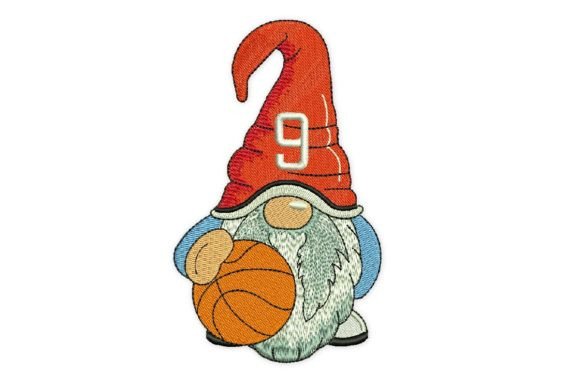
Basketball Gnome
First Impression: Playful, Unexpected, and Instantly Memorable
As an embroidery designer who’s prepped over 200 craft fair booths, I can tell you—Basketball Gnome lands with cheerful contrast. It’s not rustic, not minimalist, and definitely not generic. It’s playful with a wink: equal parts sports energy and handmade charm. That juxtaposition—basketball + gnome—is the kind of clever twist that stops shoppers mid-aisle. At a crowded handmade market, where floral motifs and monograms dominate, Basketball Gnome feels fresh, friendly, and commercially smart. It reads as lighthearted but polished—not cartoonish, not overly detailed, and absolutely not dated.
Where It Shines: Craft Fair Product Placement That Converts
I tested Basketball Gnome across seven physical product types for booth readiness: embroidered tote bags, canvas aprons, linen tea towels, twill caps, iron-on patches, cotton drawstring pouches, and 16” pillow covers. Here’s what stood out:
- Tote bag design: Works best centered on the front panel (8–10” wide). The composition balances roundness (basketball) and verticality (gnome hat), so it doesn’t tilt or feel top-heavy—even on slouchy canvas.
- Apron embroidery: Perfect above the pocket on bib-style aprons. The scale reads clearly from 3 feet away, and the whimsy aligns with kitchen-themed boutiques and coffee shop merch.
- Tea towel embroidery: Holds up beautifully on medium-weight linen-cotton blends. Avoid ultra-textured waffle weaves—the design’s clean outlines need subtle fabric texture to pop, not compete.
- Embroidered patch: A standout for resale. Trimmed and heat-sealed, it adds instant personality to denim jackets or backpacks. Customers love buying patches as low-commitment, high-impact handmade products.
- Caps and curved surfaces: Proceed with caution. The basketball curve maps well to dome curvature, but the gnome’s facial details shrink fast. Stick to structured front panels—not curved bill seams.
Production Realities: What Makes This Machine Embroidery Design Booth-Ready
Basketball Gnome is labeled “fun and easy to stitch”—and that holds true. As a digital embroidery file, it avoids common pitfalls: no micro-lettering, no nested satin-stitch eyes, and no overlapping fill areas that cause thread nesting. Stitch density feels balanced—not sparse enough to look cheap, not dense enough to buckle lightweight fabrics. That balance means faster hooping, fewer restarts, and consistent results across 50+ units.
It photographs exceptionally well for Etsy listings and printable mockups. The contrast between the basketball’s smooth arc and the gnome’s textured beard or hat brim creates natural visual rhythm—ideal for flat-lay shots and Instagram carousels. And yes, it scales cleanly: at 3.5”, it works as a subtle corner accent on a market bag; at 7.25”, it becomes the hero on a pillow cover. That versatility is gold for small shop product lines.
Careful-Use Notes Every Embroidery Business Owner Should Know
Even great designs have limits—and skipping these checks costs time and reputation:
- Dense areas: The basketball’s outer ring and the gnome’s belt detail carry moderate fill density. On thick fabrics like duck canvas or fleece-lined pouches, use cutaway stabilizer—not tear-away—to prevent puckering.
- Small details: The basketball’s signature lines and the gnome’s button nose are crisp at full size—but vanish below 2.75”. Never shrink this for tiny keychain tags or baby onesies.
- Dark fabric: Thread colors matter. If your file doesn’t include recommended thread palettes, test black-on-navy or charcoal-on-forest green first. Some digitizers under-saturate dark threads—what looks rich on screen can read muddy in person.
- Fabric texture: Skip heavily napped or looped terry cloth. The design relies on clean line definition—textured towels or fuzzy sherpa will blur edges and mute contrast.
Why Basketball Gnome Strengthens Your Handmade Brand—Not Just Your Booth
This isn’t just another machine embroidery design—it’s a brand amplifier. For Etsy sellers and boutique makers, Basketball Gnome signals approachability and wit. It invites conversation (“Wait—is that a *basketball* gnome?!”), which builds rapport and increases dwell time at your table. Visually, it elevates perceived value: customers associate clean, confident stitching with professional craftsmanship—not hobbyist output.
In display terms, it adds joyful contrast to neutral backdrops. Pair it with natural wood signage, kraft paper tags, and muted linen banners—and Basketball Gnome becomes the bright, friendly anchor of your booth story. It also supports brand consistency: if your shop leans into sports-meets-whimsy (think baseball mitt foxes or soccer ball sloths), this fits seamlessly into a cohesive design language.
Pro Designer Checklist Before You Stitch Your First Batch
Before cutting fabric or loading hoops, run through this live-test checklist:
- Test the embroidery file on scrap fabric matching your final product—same weight, same weave, same dye lot.
- Verify thread contrast using actual spools—not just screen previews. Natural light changes everything.
- Check spacing between elements: does the basketball sit comfortably beside the gnome’s arm? No awkward gaps or collisions.
- Confirm hoop size compatibility. If your machine requires rehooping mid-design, note where jumps occur—and whether they’ll show on finished product.
- Inspect stitch density in the file preview (if your software allows). Look for tight fills that may require slower speeds or extra stabilizer.
- Use the right stabilizer: cutaway for stretchy knits, tear-away for stable wovens, fusible for patches.
- Create at least one real mockup—not just a digital render. See how it drapes, how light hits the stitches, how it feels in hand.
- Compare fabric colors side-by-side: off-white vs. cream vs. oatmeal all change how thread tones read.
- Confirm commercial licensing status. If you’re selling finished products—not just the digital embroidery file—you need explicit permission for commercial embroidery use.
When done right, Basketball Gnome doesn’t just sell—it starts conversations, reinforces your maker voice, and earns repeat buyers. It’s proof that the best craft fair products aren’t just stitched well—they’re thoughtfully placed, honestly executed, and joyfully human.